 e9e0001ef8
Enable `contextIsolation` in Electron to securely expose a limited set
of Node.js APIs to the renderer process. It:

1. Isolates renderer and main process contexts. It ensures that the
   powerful main process functions aren't directly accessible from
   renderer process(es), adding a security boundary.
2. Mitigates remote exploitation risks. By isolating contexts, potential
   malicious code injections in the renderer can't directly reach and
   compromise the main process.
3. Reduces attack surface.
4. Protect against prototype pollution: It prevents tampering of
   JavaScript object prototypes in one context from affecting another
   context, improving app reliability and security.

Supporting changes include:

- Extract environment and system operations classes to the infrastructure
  layer. This removes node dependencies from core domain and application
  code.
- Introduce `ISystemOperations` to encapsulate OS interactions. Use it
  from `CodeRunner` to isolate node API usage.
- Add a preloader script to inject validated environment variables into
  renderer context. This keeps Electron integration details
  encapsulated.
- Add new sanity check to fail fast on issues with preloader injected
  variables.
- Improve test coverage of runtime sanity checks and environment
  components. Move validation logic into separate classes for Single
  Responsibility.
- Improve absent value test case generation.
privacy.sexy — Now you have the choice
Enforce privacy & security best-practices on Windows, macOS and Linux, because privacy is sexy 🍑🍆














Get started
- 🌍️ Online: https://privacy.sexy.
- 🖥️ Offline: Check releases page, or download directly for: Windows, macOS, Linux.
Online version does not require to run any software on your computer. Offline version has more functions such as running the scripts directly.
💡 You should apply your configuration from time to time (more than once). It would strengthen your privacy and security control because privacy.sexy and its scripts get better and stronger in every new version.
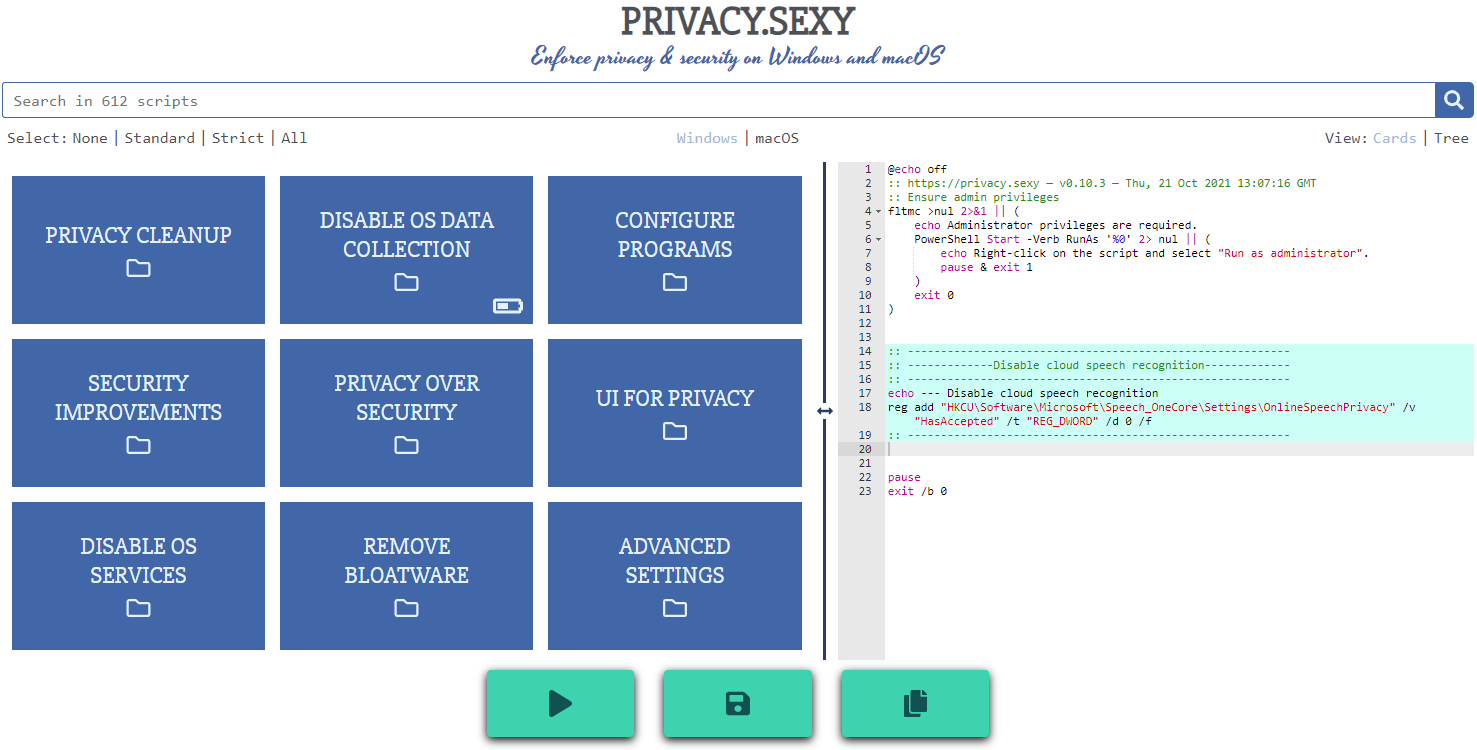
Features
- Rich: Hundreds of scripts that aims to give you control of your data.
- Free: Both free as in "beer" and free as in "speech".
- Transparent. Have full visibility into what the tweaks do as you enable them.
- Reversible. Revert if something feels wrong.
- Accessible. No need to run any compiled software on your computer with web version.
- Open. What you see as code in this repository is what you get. The application itself, its infrastructure and deployments are open-source and automated thanks to bump-everywhere.
- Tested. A lot of tests. Automated and manual. Community-testing and verification. Stability improvements comes before new features.
- Extensible. Effortlessly extend scripts with a custom designed templating language.
- Portable and simple. Every script is independently executable without cross-dependencies.
Support
Sponsor 💕. Consider sponsoring on GitHub Sponsors, or you can donate using other ways such as crypto or a coffee.
Star 🤩. Feel free to give it a star ⭐ .
Contribute 👷. Contributions of any type are welcome. See CONTRIBUTING.md as the starting point. It includes useful information like how to add new scripts.
Development
Refer to development.md for Docker usage and reading more about setting up your development environment.
Check architecture.md for an overview of design and how different parts and layers work together. You can refer to application.md for a closer look at application layer codebase and presentation.md for code related to GUI layer. collection-files.md explains the YAML files that are the core of the application and templating.md documents how to use templating language in those files. In ci-cd.md, you can read more about the pipelines that automates maintenance tasks and ensures you get what see.
docs/ folder includes all other documentation.