 undergroundwires
b68711ef88
undergroundwires
b68711ef88
- Migrate feature disablement to PowerShell for clarity and robustness.
- Improve log outputs and error handling for missing or default-disabled
  features. This fixes false-positive errors by treating the absence of
  a targeted feature as a success condition, and treats features
  disabled by the OS as non-issues.
- Fix revert logic to align with OS defaults, correcting previous
  behavior that indiscriminately enabled features without considering
  their default state.
- Fix usage of incorrect feature name for `LDPPrintService`, correcting
  attempts to disable a non-existing feature.
- Standardize script recommendations for outdated or missing features
  on modern Windows versions by recommending them on 'Standard'
  selection, providing clearer guidance for users.
- Rename feature-related scripts for consistency with Windows display
  names, improving consistency and script discoverability.
- Expand documentation for all feature-disabling scripts, adding
  details such as display names, descriptions, and default states,
  thereby informing users about the specifics and rationale of each
  script.
- Rename `DisableFeature` function to `DisableWindowsFeature` for
  increased descriptiveness and alignment with PowerShell conventions.
- Harmonize the use of the `DisableWindowsFeature` function across
  scripts targeting various features, including SMBv1 and PowerShell
  2.0 downgrade attacks, enhancing consistency and maintainability.
- Add code comments in the generated disable/enable feature scripts,
  improving understandability for users.
- Add the ability to revert to default OS behavior for feature
  enablement/disablement to align with OS defaults.
privacy.sexy — Privacy is sexy
Enforce privacy & security best-practices on Windows, macOS and Linux, because privacy is sexy.
















Get started
- 🌍️ Online: https://privacy.sexy.
- 🖥️ Offline: Download directly for: Windows, macOS, Linux. For more options, see here.
For a detailed comparison of features between the desktop and web versions of privacy.sexy, see Desktop vs. Web Features.
💡 Regularly applying your configuration with privacy.sexy is recommended, especially after each new release and major operating system updates. Each version updates scripts to enhance stability, privacy, and security.
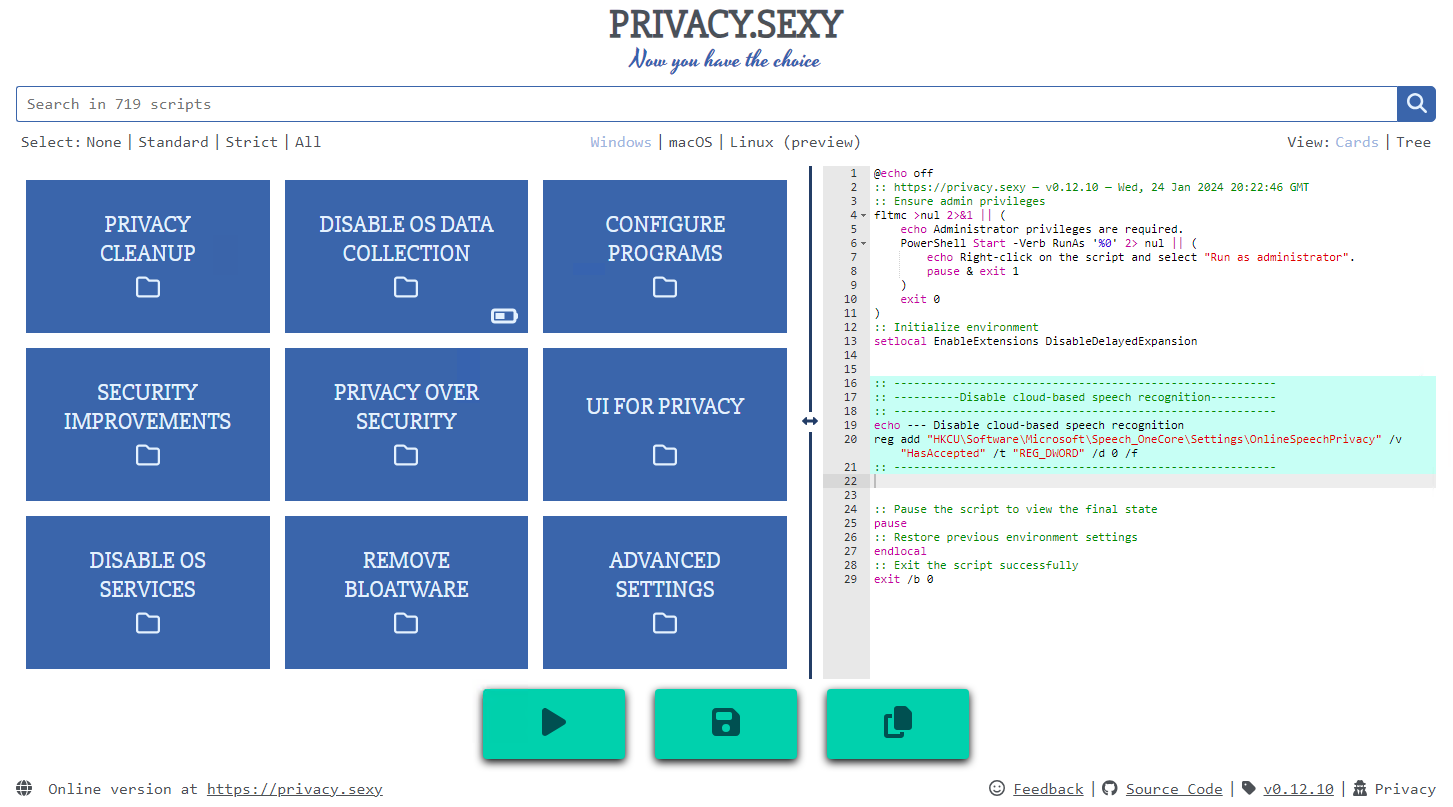
Features
- Rich: Hundreds of scripts that aims to give you control of your data.
- Free: Both free as in "beer" and free as in "speech".
- Transparent. Have full visibility into what the tweaks do as you enable them.
- Reversible. Revert if something feels wrong.
- Accessible. No need to run any compiled software on your computer with web version.
- Secure: Security is a top priority at privacy.sexy with comprehensive safeguards in place.
- Open. What you see as code in this repository is what you get. The application itself, its infrastructure and deployments are open-source and automated thanks to bump-everywhere.
- Tested. A lot of tests. Automated and manual. Community-testing and verification. Stability improvements comes before new features.
- Extensible. Effortlessly extend scripts with a custom designed templating language.
- Portable and simple. Every script is independently executable without cross-dependencies.
Support
Sponsor 💕. Consider sponsoring on GitHub Sponsors, or you can donate using other ways such as crypto or a coffee.
Star 🤩. Feel free to give it a star ⭐ .
Contribute 👷. Contributions of any type are welcome. See CONTRIBUTING.md as the starting point. It includes useful information like how to add new scripts.
Additional Install Options
- Check the releases page for all available versions.
- Other unofficial channels (not maintained by privacy.sexy) for Windows include:
-
Scoop 🥄 (latest version):
scoop bucket add extras scoop install privacy.sexy -
winget 🪟 (may be outdated):
winget install -e --id undergroundwires.privacy.sexyWith winget, updates require manual submission; the auto-update feature within privacy.sexy will notify you of new releases post-installation.
-
Development
Refer to development.md for Docker usage and reading more about setting up your development environment.
Check architecture.md for an overview of design and how different parts and layers work together. You can refer to application.md for a closer look at application layer codebase and presentation.md for code related to GUI layer. collection-files.md explains the YAML files that are the core of the application and templating.md documents how to use templating language in those files. In ci-cd.md, you can read more about the pipelines that automates maintenance tasks and ensures you get what see.
docs/ folder includes all other documentation.
Security
Security is a top priority at privacy.sexy. An extensive commitment to security verification ensures this priority. For any security concerns or vulnerabilities, please consult the Security Policy.