 undergroundwires
3a594ac7fd
undergroundwires
3a594ac7fd
All outbound links now include `rel="noopener noreferrer"` attribute.
This security improvement prevents the new page from being able to
access the `window.opener` property and ensures it runs in a separate
process.

`rel="noopener"`:

   When a new page is opened using `target="_blank"`, the new page runs
   on the same process as the originating page, and has a reference to
   the originating page `window.opener`. By implementing
   `rel="noopener"`, the new page is prevented to use `window.opener`
   property.
   It's security issue because the newly opened website could
   potentially redirect the page to a malicious URL. Even though
   privacy.sexy doesn't have any sensitive information to protect, this
   can still be a vector for phishing attacks.

`rel="noreferrer"`:

  It implies features of `noopener`, and also prevents `Referer` header
  from being sent to the new page. Referer headers may include
  sensitive data, because they tell the new page the URL of the page
  the request is coming from.
privacy.sexy — Now you have the choice
Enforce privacy & security best-practices on Windows, macOS and Linux, because privacy is sexy 🍑🍆













Get started
- 🌍️ Online: https://privacy.sexy.
- 🖥️ Offline: Check releases page, or download directly for: Windows, macOS, Linux.
Online version does not require to run any software on your computer. Offline version has more functions such as running the scripts directly.
💡 You should apply your configuration from time to time (more than once). It would strengthen your privacy and security control because privacy.sexy and its scripts get better and stronger in every new version.
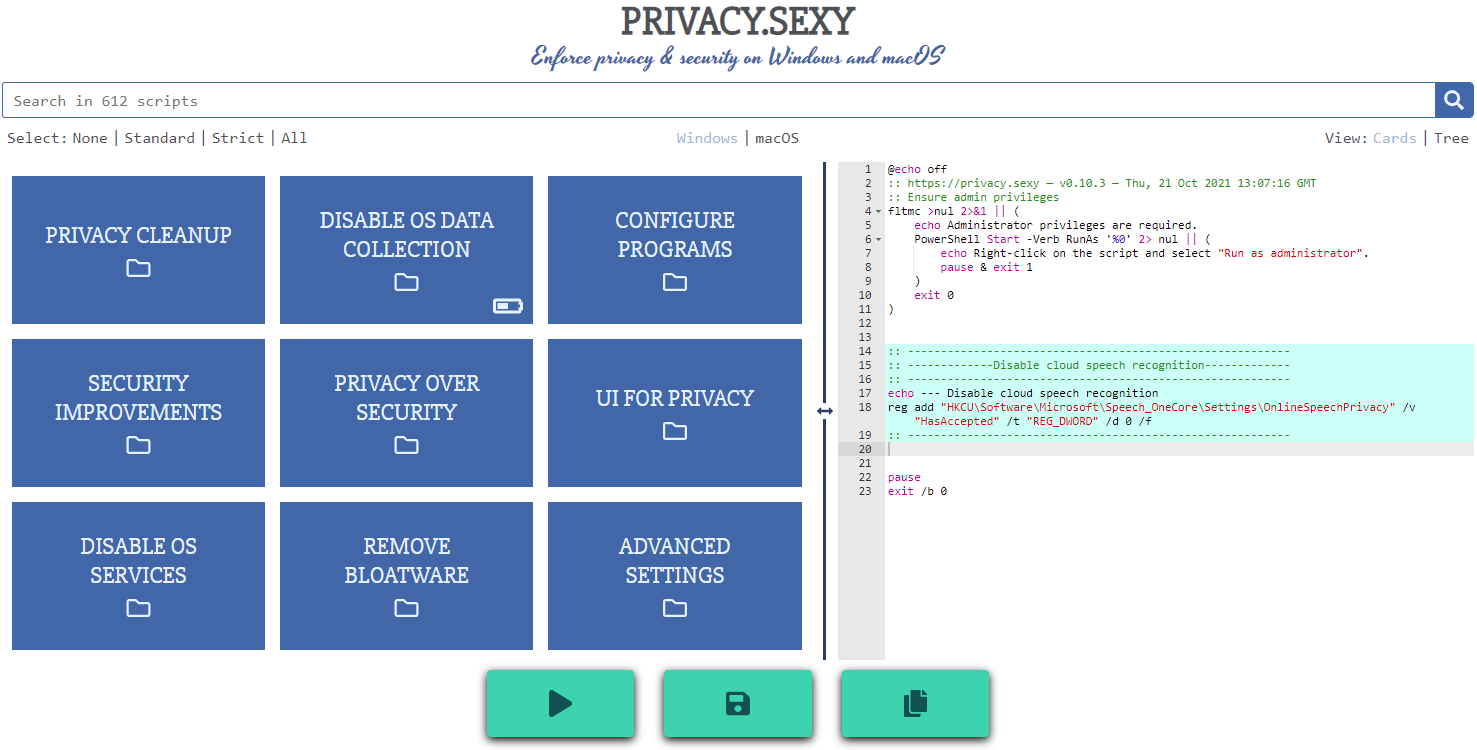
Features
- Rich: Hundreds of scripts that aims to give you control of your data.
- Free: Both free as in "beer" and free as in "speech".
- Transparent. Have full visibility into what the tweaks do as you enable them.
- Reversible. Revert if something feels wrong.
- Accessible. No need to run any compiled software on your computer with web version.
- Open. What you see as code in this repository is what you get. The application itself, its infrastructure and deployments are open-source and automated thanks to bump-everywhere.
- Tested. A lot of tests. Automated and manual. Community-testing and verification. Stability improvements comes before new features.
- Extensible. Effortlessly extend scripts with a custom designed templating language.
- Portable and simple. Every script is independently executable without cross-dependencies.
Support
Sponsor 💕. Consider sponsoring on GitHub Sponsors, or you can donate using other ways such as crypto or a coffee.
Star 🤩. Feel free to give it a star ⭐ .
Contribute 👷. Contributions of any type are welcome. See CONTRIBUTING.md as the starting point. It includes useful information like how to add new scripts.
Development
Refer to development.md for Docker usage and reading more about setting up your development environment.
Check architecture.md for an overview of design and how different parts and layers work together. You can refer to application.md for a closer look at application layer codebase and presentation.md for code related to GUI layer. collection-files.md explains the YAML files that are the core of the application and templating.md documents how to use templating language in those files. In ci-cd.md, you can read more about the pipelines that automates maintenance tasks and ensures you get what see.
docs/ folder includes all other documentation.